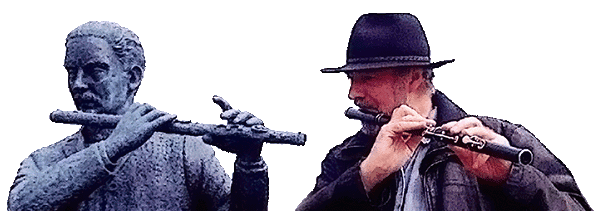
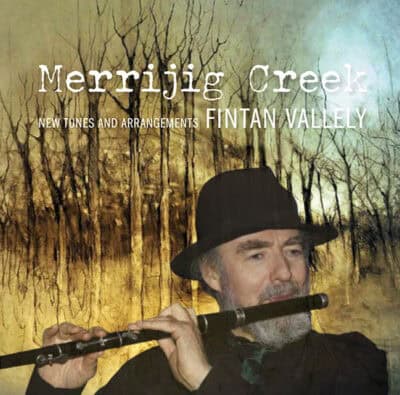
Merrijig Creek – New Tunes and Arrangements
New tunes and arrangements by Fintan Vallely, with Caoimhín Vallely, piano; Sheena Vallely, flute; Brian Morrissey, percussion; Liz Doherty, fiddle; Dáithí Sproule, guitar; Gerry O’Connor, fiddle.
28 new tunes and arrangements on concert flute marking Fintan Vallely’s fifty-seventh year playing music.
With him is his sister Sheena Vallely, also on flute, who as a painter and musician has lived much of her working and playing life in London and Bristol. Framing and highlighting the music with piano melody and accompaniment is their cousin Caoimhín Vallely, a founder-member of the bands North Cregg and Buille. On bodhrán and percussion is Tipperary-born Brian Morrissey, and on fiddle is Donegal player Liz Doherty, of Nomos, Fiddlesticks, The Bumblebees and the international String Sisters. Also on fiddle is Gerry O’Connor from Dundalk, of the band Skylark and, with Eithne Ní Uallacháin, Lá Lugh; with Fintan he also performs the audiovisual concert shows Compánach and Turas. Guitarist Dáithí Sproule, both a soloist and singer, as well as having been member of Skara Brae, has toured and recorded with Altan and Liz Carroll.
Fintan is privileged to be buoyed along by the enervating nerve of this company: Sheena’s sympathetic flute pulse, Caomhín’s lift on piano, with Brian accenting moods on bodhráns and shakers. Dáithí is on guitar on track five, Liz is on several sets, and Gerry joins on the finale tunes. The intuitive production and direction input of Niall Vallely (a composer himself, of the bands Nomos and Buille), is greatly appreciated for his patient shepherding of balance, character and vitality in the album.
Set 1: The Three Sisters
This set of three melodically-related tunes follows a trajectory which began in the wonderful, enabling environment of a residency in Varuna, the National Writers’ House, at Katoomba, close to The Three Sisters peaks of the Blue Mountains of New South Wales in October, 2013. Sponsored by the Tyrone Guthrie Centre at Annaghmakerrig, Co. Monaghan, this exchange gave me contemplative time in the garden study of the centre’s mentor, writer Eleanor Dark, she who donated the Varuna house as an arts resource.
The first tune, `An grianán feasa’ (‘The wise cheerful one’), came together there, a re-working of the song ‘Bold Doherty’ which was collected from Mary Ann Carolan in Co. Louth by Sean Corcoran. ‘Grianán’ indicates ‘a person of sunny disposition’, and ‘feasa’ depth of knowing. Together, these terms seem to express the feel of the tune for the self-belief and commitment which have passionately been put into society-changing endeavours by idealists, dreamers and activists of the past in music, writing, poetry, painting, drama, film, sport and politics. In the foreground amongst the many of these who added much to my own life experience are Muiris Ó Rócháin of Scoil Samhraidh Willie Clancy, the prisoners’ rights pioneer Margaret Gaj, Na Píobairí Uilleann’s founder Breandán Breathnach, Máire Comerford, a First Dáil secretary, piper Sean Reid and indeed my own father James, Irish pole-vault champion, athletics promoter, and apple grower.
‘Merrijig Creek’ is a jig development out of that air, named for what is an Aboriginal term said to mean something similar to the Irish ‘Grand!’. It is the name of a dry creek in Gippsland, south of Melbourne, marked by a lone sign on the Great Ocean Road, and it is also a one-time gold town close to where the film of Banjo Paterson’s recitation ‘The man from Snowy river’ was shot.
‘The Clonakilla’ leads the theme further astray and back to an Irish connection, working it into 4/4 time on a tune named after the famous winery near Yass, New South Wales, started by Seán Ó Riada’s Lisdoonvarna-connected cousin, fiddle-player and scientist John Kirk, who pioneered wine production in that region of Australia.
Played by Fintan, Sheena & Caoimhín.
Set 2: From Ballinakill to Ballinascreen
In 1988, while playing with Tim Lyons in England I had the privilege of meeting the East Galway, London based fiddler Lucy Farr who arrived to renew acquaintance with Tim at our gig at Nettlebed Folk Club in Oxfordshire. She gave me recordings of tunes she composed and invited us to play them, which we did delightedly for several years. Now, by way of cementing the pledge, here are two of Lucy’s slides from c. 1972, in a style which is a mix of her own East Galway lonesomeness, and her fiddle-playing colleague Julia Clifford’s Sliabh Luachra lift; ‘The Shoemaker’ is the first, followed by ‘Music on the Wind’.
The reel that follows is ‘The Banba’, in a flute-friendly fingering, a title that was common in post-independence Ireland, it being one of the ancient names for the island. Brian O’Higgins had The Banba Press, as had a famous Dublin toy- and book-shop chain, the descendant of which still carries the name. Here ‘Banba’ commemorates a céilí band in which my maternal grandfather, fiddle-player Frank Kelly , played for pre-WW2 céilís at The Banba Hall in Draperstown/Ballinascreen, Co. Derry. A joiner by trade, Frank made his own fiddle, not surprising indeed, as his reputed ancestors were harp-makers, among them John Kelly who made the ‘Bunworth harp’ in the end of the seventeen hundreds. Frank’s son, Brendan made crafted, artistic harp models in Toronto, to where he had emigrated in the 1950s, and the other son, Frank, made full-size harps there in the 1990s.
Played by Fintan, Sheena and Caoimhín, with Niall on whistle.
Set 3: Emilia Romagna Redoubt
Photo-journalist Fulvio Grimaldi and singer Pino Masi introduced me to a thrilling world of politically-driven music in Italy in 1973. This led to my witnessing the spectacular annual commemoration for trade unionists who had been shot by police in Reggio Emilia in 1960.
That tragedy is sung in Fausto Amodei’s ‘Per i Morti di Reggio Emilia’, played here on flute with piano, a poignant, march-tempo ballad which I first heard ringing through the hills sung by a thousand voices against a backdrop of red flags flying from every house, business and church.
The following ‘Reggio Jig’ was developed out of the song, marking the day in mixed time.
Played by Fintan, Caoimhín and Brian.
Set 4: Roving Rhythm
This set opens with the song-air ‘The Wounded Huzzar’, the tune of 18th-century Scottish poet Thomas Campbell’s popular lyric. Campbell was an unrepentant Jacobite whose poetry in print was immensely favoured in Ireland. Born in Glasgow, and a contemporary of Edward Bunting, he was an ardent believer in political reform. He is known for ‘The Pleasures of Hope’, 1799, memorable for the line therein “Tis distance lends enchantment to the view”. A popular poet, he was three times elected Lord Rector of Glasgow University, on the last occasion defeating Walter Scott; he retired to Boulogne in 1843 to get out of the rat-race. The subject of the lyric may be one of the gallowglasses who, after Culloden, left Scotland with their families and went into the service of Poland.
English fiddle-player Pete Cooper saw that the air to which it has been sung is the same as the following tune, ‘Captain O’Kane’, a piece attributed to the 17th-18th century harper Turlough Carolan.
This leads to one of many variations of a terrific reel, this one named for a famous music bar in West Clare ‘The Crosses of Annagh’. It was made by the East Galway fiddler Tommy Coen, and in its original form is usually known as ‘Coen’s Memories’.
Played by Fintan and Dáithí.
Set 5: The Humours of Blundell's Grange
This celebrates my primary-school entry to enlightenment in a fiercely distinctive townland of characters, where I was moulded by my rigorous uncle into scholarship material for secondary education, escape to university, careering eventually into music and commentary thereon. I grew up off a long lane in that North Armagh country, celebrated in the first tune ‘The Dark Loanen’, a narrow communications link so called on account of its being bounded by high, hawthorn hedges which met at the top, making it a veritable tunnel in summer. My cousin Niall was so taken by its name that he composed a tune for it, played here in honour of the ancestral homestead.
This celebrates my primary-school entry to enlightenment in a fiercely distinctive townland of characters, where I was moulded by my rigorous uncle into scholarship material for secondary education, escape to university, careering eventually into music and commentary thereon. I grew up off a long lane in that North Armagh country, celebrated in the first tune ‘The Dark Loanen’, a narrow communications link so called on account of its being bounded by high, hawthorn hedges which met at the top, making it a veritable tunnel in summer. My cousin Niall was so taken by its name that he composed a tune for it, played here in honour of the ancestral homestead. The following reel, ‘The Miltown Collector’, is a tribute to Tom Munnelly, an erudite and witty song-collector who made Miltown Malbay his home, engaging thoroughly, and beyond the call, with his subjects to the great, memorable pleasure of all. He it was who brought the Traveller John Reilly’s songs into modern light, and, via the Folklore Department of UCD, performed a behind-the-scenes, vital function in preserving sung songs and linking them to printed texts. The final reel jumps tempo again, ‘Maisie Friel’s, still in Co. Clare, a tune with a boisterous, mischievous feel of crack to it, in honour of a tremendous, spirited woman who with Thomas, and, later, their sons, ran the famous session emporium in Miltown Malbay, Co. Clare where many teeth in music were cut, where all the great performers have played, and where hospitality has been legendary. The pub remains socially and musically central in the annual Scoil Samhraidh Willie Clancy, almost as iconic as the piper himself. Played by Fintan, Sheena, Caoimhín and Liz.
The following reel, ‘The Miltown Collector’, is a tribute to Tom Munnelly, an erudite and witty song-collector who made Miltown Malbay his home, engaging thoroughly, and beyond the call, with his subjects to the great, memorable pleasure of all. He it was who brought the Traveller John Reilly’s songs into modern light, and, via the Folklore Department of UCD, performed a behind-the-scenes, vital function in preserving sung songs and linking them to printed texts.
The final reel jumps tempo again, ‘Maisie Friel’s’, still in Co. Clare, a tune with a boisterous, mischievous feel of crack to it, in honour of a tremendous, spirited woman who with Thomas, and, later, their sons, ran the famous session emporium in Miltown Malbay, Co. Clare where many teeth in music were cut, where all the great performers have played, and where hospitality has been legendary. The pub remains socially and musically central in the annual Scoil Samhraidh Willie Clancy, almost as iconic as the piper himself.
Played by Fintan, Sheena, Caoimhín and Liz
Set 6: Gregorium Uproarium
This emerged in 1977 out of listening to John Coltrane’s exploration of melody. Its opening lament and slow reel ‘Ómós Tadhg MacSweeney’ are dedicated to the prolific West Cork painter Tadhg MacSweeney. He shared fixer-upper rooms with myself and other artists in an 18th-century, former tenement house owned by the philanthropic architect Uinseann Mac Eoin at 5 Henrietta Street, in Dublin in the 1970s. Tadhg’s dedication to his art, and his subtle, enabling encouragement to others in the house, nudged me back to playing after a drop-off in the early seventies, and indeed, when my mother visited once, gave her the bug to take up painting herself, something she stuck with for the next thirty years. Tadhg’s sisters Bríd and Máire, in the family home on an organic farm at Cill na Martra, had a house open to artists and craftspeople too – a hospitality greatly appreciated by us all. The optimistic enthusiasm emanating from both there and Henrietta Street was also to be greatly inspirational to sculptor Pat Bracken who went on to make spectacular puppets for Macnas in Galway, to film-maker Trish McAdam, and to graphic artist Gerry Sandford who for many years designed London’s Time-Out magazine and, later, The Sunday Tribune newspaper in Dublin. Dancer Tony Rudenko and a photographer were there too, and, later, sculptor Gabby Dowling and actor Eamonn Hunt.
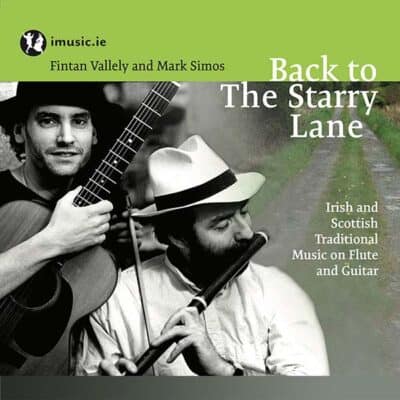
This music set was played by me at gigs in Ireland, Italy and America with guitarist tunesmith Mark Simos, now a song-writing prof. with Berklee College, Boston. He worked out the linking riffs, and we recorded it on The Starry Lane to Monaghan in 1992, an album remastered as Back to the Starry Lane in 2021.
The tunes which follow are the germ of the first, the related ‘Raithneach a Bhean Bheag’ and variations on the reel ‘The Musical Priest’.
Played by Fintan, Caoimhín and Brian.
Set 7: Homage to Brian Keenan
These are tunes named for the Belfast man who between 1986 and 1990 spent four and a half years in darkness as a hostage in captivity following his kidnap while a teacher in Beirut, Lebanon. As details of the process of his release and return to Ireland were incrementally broadcast on radio, the sense of elation generated came to be reflected in these three tunes which I was exploring at the time.
‘Syrian Sky’ is a slow-air treatment of the two reels which follow. Its format evokes the open-metre feel of Arabic oboe and bagpipes music, implying abandon, and light itself, then suggesting caution, doubt perhaps, before moving to confidence and elation.
‘Trip to Damascus’ is in reel form, tuning in to disbelief, then the slow glow of ecstasy Keenan is assumed to have felt while still in the land of his captors, but being driven into liberty.
‘Farewell to Lebanon’ is a reel about leaving that all behind, still with an Arabic feel, but in an Irish mode, if at the top end of the common scales. Much of these sentiments are found in Keenan’s autobiographical account of his and John McCarthy’s captivity, An Evil Cradling. The darkness aspect of Brian’s isolation gave him an empathy with the harper Carolan, based on the experience of having once being able to see, and then having that shut off; this became the subject of his subsequent, remarkable, fact-based novel on Carolan, Turlough.
Played by Fintan (flute and whistle) and Brian (tambourines and idiophones).
Set 8: The Maid of Annaghmakerrig
The theatre director Tyrone Guthrie had his mother’s family home at Annaghmakerrig, near Newbliss, Co. Monaghan until his death in 1971. From 1963 he developed the Guthrie Theatre in Minneapolis, a city which many notable Irish musicians have made their home, including Derry guitarist and singer Daithí Sproule, and Offaly accordionist Paddy O’Brien. Judith, who was married to Guthrie, of course played a role in the great man’s trajectory, but, of its time, this was unmarked. The house was donated jointly to the Arts Councils on Guthrie’s death, and opened as an arts residency in 1981.
Writer Evelyn Conlon, who was on its board, once remarked to the Director, Bernard Loughlin, on Judith’s invisibility, an observation that led to an invitation to research the woman’s influence. Since this was being done at the same time as this tune came together, ‘Judith Guthrie’s Jig’ took over as the title, not least on account of my Minnesota friends, among them dancer, music organiser and artist Nick Lethert, Dáithí Sproule himself, fiddle-player Mary MacEachron, small-piper and flute-player Laura MacKenzie, and dancers including Liz Welch and Sheila Jordan.
The introductory piece ‘Fool’s Errand’, titled after a poem of Dermot Healy’s, is a re-working as an air of the jig which follows; this was done originally for performance with Dermot in one of our recitals recorded by RTÉ. The jig has shadows of Balkan influence perhaps, as it came after the first of my music explorations in Bulgaria, on one of which in 1993 I led Siamsa Tíre’s Fr. Pat Ahern and Martin Whelan in a recce of folk-dance colleges in the country following the opening of the Berlin Wall. The urge to be there was sparked by Trio Bulgarka’s song and associated music, a passion for Bulgarian music idioms that I shared with flute-player and sculptor Eamonn O’Doherty and Planxty instrumental wizard Andy Irvine.
Played by Fintan, Caoimhín and Brian.
Set 9: The Rambles of Grappa
Each of these tunes is a pole of my music experience. ‘Valentia Regatta’ was heard from Dublin flute player Mick Gavin in the seventies. Once, a decade later, after I played it at a Willie Clancy recital, ex-Ceoltóirí Chualann’s John Kelly told me that Seán Ó Riada had composed the first part for a curragh regatta in Co. Kerry, but had got stuck, and asked John if he would finish it. John obliged, appropriately, in a fashion reminiscent of the air ‘Amhrán na leabhair’, which was played by Ó Riada as ‘Cuan Bhéil Innse’ (‘Valentia Harbour’), hence the title used here.
The following barndance, ‘Garvey in the Sea’ came out of a noodling I had been doing at a time when music promoter Tom Sherlock was telling me of how the remarkable Kerry singer Sean Garvey who, having had multiple bones broken in a car crash, was practically mummified in plaster of Paris from head to toe. He had been hydrated back to health by a friend, a vet, who used water immersion as a treatment for the animals in his care: he took Sean to the beach each morning, wrapped him in latex, floated him on the waves, and so therapeutically restored him to full physical and sonorous functionality. The feel of the tune is of a bobbing in the water.
‘The Verona reel’ commemorates a 1990 tour with the Armagh Piper’s Club that began in the Italian city of that name which has a fabulous amphitheatre built 2000 years ago to seat 8000 people and is still in use for opera. The series of gigs with the Armagh Pipers’ Club, including Niall and Caoimhín, and Liz Doherty, was organised by geologist Ezio Vaccari and musicologist Allesandro Nobis. Our musical progress through Northern Italy saw us play in numerous village and city piazzas and venues around Lago di Garda, up as far as the dramatic Renaissance, star-fort commune of Palmanova, opening up a whole new potential in all of our lives.
Played by Fintan, Caoimhín and Liz.
Set 10: The Ballyconnell Colours
This named also for Dermot Healy’s work, the title of the flute-and-verse recitals which he and myself first undertook in 1988 at the invitation of Peter Sirr of the Dublin Writers’ Centre; the formula was later used by Seamus Heaney with Liam O’Flynn.
‘Five Women and a Fiddle’, the first reel, was named after a 1980s concert organised by Evelyn Conlon as a celebration of women artists, its title inspired by the performance there of five writers with the Dublin composer and fiddle-player Máire Breathnach.
‘The Rockforest Reel’ was named, out of a chance meeting, for the big-house, Anglo-Irish seat of the family of one Brian Gibson who attended a Scitheredee concert of myself and Tim Lyons in Sutherland, Scotland in 1988. Gibson’s Burke’s-Peerage-listed father had not been hostile to Irish independence and so, in 1921 when they were relieved of their mansion, Rockforest Hall near Roscrea, he opted to move to farm in Scotland rather than follow the family to England. The building had been burnt of course, and a bungalow eventually built on the site. At Brian’s request I located the plans of the old house, which led to convivial meetings and MacAllan-ising between he and the ‘new’ owner and his nephew, Con Manning, an archaeologist with the Board of Works.
The final tune of the album, ‘The Wild Goose Chase’ came, like the creatures it emulates, out of the blue in the course of recitals done with Dermot Healy, who by then had just completed a collection of poetry celebrating the nuances in the seasonal comings and goings of the geese on Inismurray island off Co. Sligo, near to where he and Helen spent his latter years surrounded by the ocean. Somewhere in the repetitive riffs there is echo of the haunting guldering of hundreds of migrating geese year after year over centuries, majestic birds utterly unfazed by the massive social and technological readjustments that we mere mortals are obsessed with, and which have rendered Inismurray now home only to geese.
Played by Fintan, Sheena, Caoimhín, Brian, Liz and Gerry.
The music
Some of the new tunes here emerged out of the headiness of days-long session immersions in counties Dublin, Sligo and Clare. Others came while touring, on long road trips on the neighbouring island. Eighteen of the twenty-eight pieces were made by me between the years 1977 and 2017; the other ten are favoured, complementary pieces that came out of travel, session playing and listening.
The few older tunes and Lucy Farr’s pieces are felt as a leavening matrix for the newer material which has been re-worked and honed over years, and was eventually coaxed to finality in the head-space freed up by a Deis grant from An Comhairle Ealaíon / The Arts Council of Ireland.
A couple of the new tunes were recorded with Mark Simos in 1992, but most have not been played in music circles before. They were played, however, at literary events, from the mid 1990s though to 2007 in Ireland and Scotland with the poet Dermot Healy as part of the spoken-word presentations The Ballyconnell Colours and Fool’s Errand for which familiar tunes were just not appropriate.
The naming of the new tunes follows the convention in Irish Traditional music: their titles indicate stories, history, places, significant events and people over the course of my performing life. So too with the group-titling of the ‘sets’, which is related to personal and circumstantial associations, a practice that has been with us since the advent of the CD in the eighties.
Making new tunes
There are many beliefs and assumptions about the ancientness of the airs and dance tunes in Irish Traditional music: “from back in the mists of time”, “learnt from the fairies”, “heard on the wind”. The stories are comforting folklore, and most are at least partly true, for thousands of jigs and reels have indeed been distilled by musicians out of centuries-old song melodies, in times when musicianship was held in high regard, and believed to be supernatural. Generally, too, the tune-names that are the handling tags for performers do always have some organic connection with real lives and happenings. The best tunes had probably already been made and were in wide circulation by the time of late twentieth century revival, making possible the phenomenal institution we know as the ‘session’. Yet tunesmiths still manage to come up with unique, compelling new melodies. In addition to this, there is also an endless potential for re-composition in the melodic contours of existing tunes – their ‘set, accented tones’, a term used by Mícheál Ó Súilleabháin for the key notes which mark out the boundaries and turns of any melody. Like an aleatoric selection-box of phrases, these are subconsciously picked through and re-applied diversely in composition. Potential is expanded further by the challenge of the Irish-music spectrum’s twenty or so different tune-types, and these themselves can be explored for additional depth and breadth by changing the key, octave or tempo. Refreshing dimension can also be given by juxtaposition of different instruments and timbres, displayed elementally in solos as ‘the raw bar’, and with aesthetic sophistication in arrangements. Ethos absorbed from other equally distinctive musics can breathe further new life: the post-1950s fascination for bass, beat and crossovers boosted revival, and orchestration has for more than a century brought out yet other drama and power.
The tunes and arrangements on this album, however, were made, as most tunes are, without consideration of any of this, casually and unplanned. Some emerged out of the headiness of days-long session immersions in counties Dublin, Sligo and Clare, others in pensive exploration while on long road trips on the neighbouring island. Like a jigsaw that begins with just two pieces, a melody starts with a few notes – maybe a favoured passage, a riff. This is gradually teased out from both ends until a phrase emerges, eventually reaching the call-and-response unit that is the first part of a tune. That then is noodled into a diversion which typically reaches up into the second octave, goes off on a brief skirmish and then lands securely back at the starting point. If the muse gets courage, the second part may lead to a third, fourth or fifth, each related to its predecessor, but eventually all returning logically to the opening. And always, in Irish music, with the invitation or compulsion to repeat the whole tune two or three times over.
Eighteen of these twenty-eight tunes were made by me between the years 1977 and 2017; the other ten are favoured, complementary pieces that came out of travel, session playing and critical listening. The older tunes and Lucy Farr’s pieces are felt as a leavening matrix for the newer material which has been honed, re-worked and rationalised at various times, and was eventually coaxed to finality in the head-space freed up by a Deis grant from An Comhairle Ealaíon / The Arts Council of Ireland. A couple of the new tunes have been recorded with Mark Simos in 1992, but most have not been played in music circles before, though I did play them from the mid 1990s though to 2007 in Ireland and Scotland with the poet Dermot Healy as part of the spoken-word presentations The Ballyconnell Colours and Fool’s Errand for which familiar tunes were just not appropriate. The naming of the new tunes follows the convention in Irish Traditional music: their titles indicate stories, history, places, significant events and people over the course of my performing life. So too with the group-titling of the ‘sets’, which is related to personal and circumstantial associations, a practice that has been with us since the advent of the CD in the eighties.
Fintan Vallely
Thanks
Many deserve sincere thanks for the process that led to this collection of music, not least An Comhairle Ealaíon’s ‘Deis’ fund which rendered it physically possible. Core among the ups, downs and travel is Evelyn Conlon whose questing led me to the productive sojourn at Varuna in Australia that began the snowball run, and whose support kept it moving; Barra Ó Seaghdha for deep interest and perpetual encouragement; Rebecca Draisey Collishaw for notating and amending transcriptions; Liz Doherty, Sheena Vallely, Nick Lethert, Jackie Small and Nicholas Carolan, variously, gave background information, assessment, checks, support and critical comment; Peter Sirr first facilitated the tunes seeing the light of day; Mark Simos whose innovation gave shape and metre; Caoimhín for his taste and empathy; and Niall for so much skill, judgment and patience.
PERFORMER INFORMATION
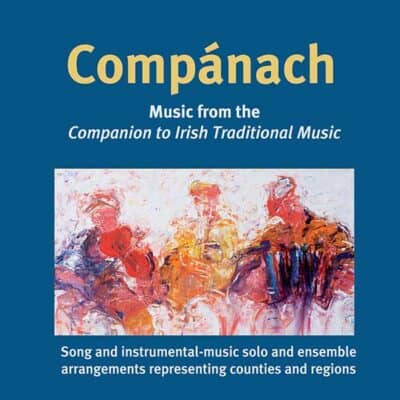
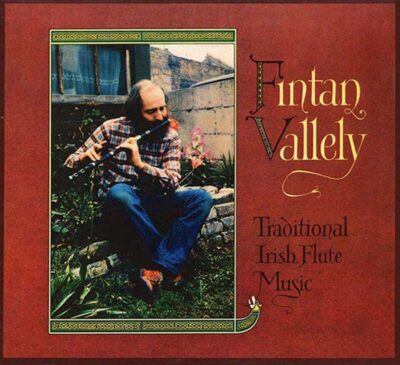
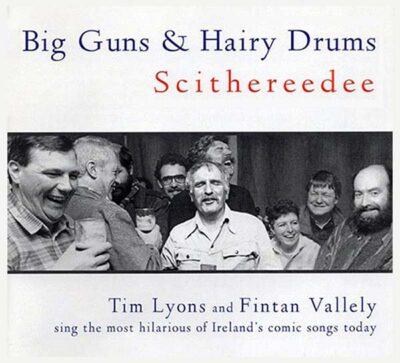
Fintan Vallely’s debut LP album and cassette Irish Traditional Music was recorded by Shanachie, New Jersey, in 1979, issued as a CD in 2008. In 1988 he recorded Knock, Knock, Knock, a cassette of satirical song and music with Tim Lyons, re-issued in CD format as Big Guns & Hairy Drums in 2000. In 1992 he recorded solo flute with Mark on guitar as The Starry Lane to Monaghan, remastered in 2021 as Back to the Starry Lane. In 2018 he recorded with others as Compánach, a double album with music from each Irish county. He brought out the first ever Irish flute tutor in 1986 (new edition 2011), was The Irish Times and Sunday Tribune critic for Irish music in the 1990s, and compiled the A-Z Companion to Irish Traditional Music (1999, 2011, 2021). Among his other writings are Sing Up! – Irish Comic Songs and Satires, and Tuned Out – Traditional Music and identity in Northern Ireland.
PUBLISHER DATA
Distributed by Whinstone.net, Dublin, Ireland WHN007
Tunes and arrangements by Fintan Vallely from 1977-2017
With Caoimhín Vallely, piano; Sheena Vallely, flute; Brian Morrissey, percussion; Liz Doherty, fiddle; Dáithí Sproule, guitar; Gerry O’Connor, fiddle.
Recorded and produced by Niall Vallely, crowvalleymusic.com, Cork, 2018-2020; supplementary recording by Donal O’Connor at Red Box Recording, Belfast, 2020. Sleeve notes by Fintan Vallely. Graphic design by Mary Guinan. Tunes © Fintan Vallely and the named composers. CDs by axisppm.com, Dublin. Published by ceolweb.ie/ and distributed by Whinstone.net Dublin, Ireland, 2020. All rights reserved. Unauthorised copying, reproduction, hiring and public broadcasting prohibited.
Listen & Download at Bandcamp:
more recordings